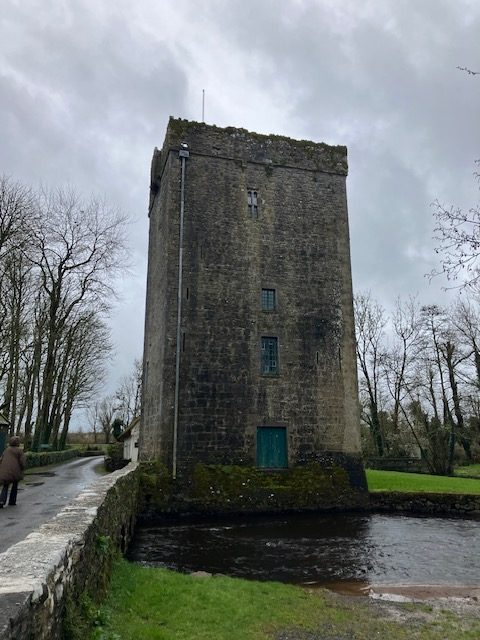
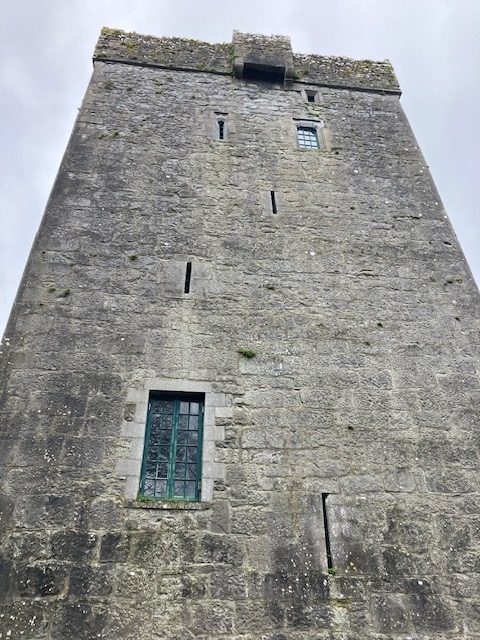
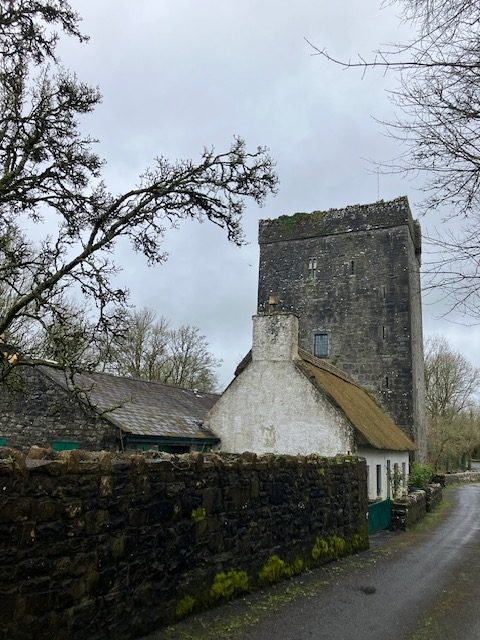
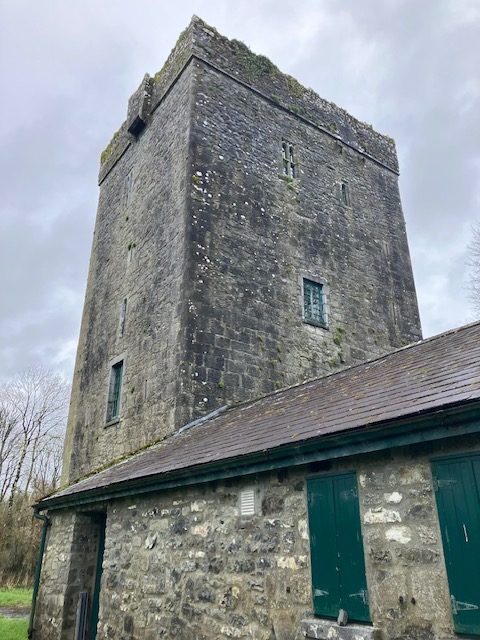
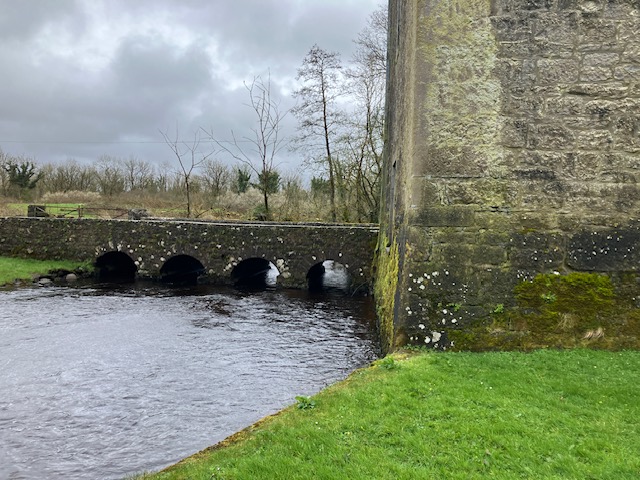
Happy belated birthday to William Butler Yeats (June 13), my earliest and chiefest poetic influence. And a happy return to the blog after a year’s hiatus. In honor of the occasion, I have embedded a few photos of his tower, Thoor Ballyee, where he and his wife George spent their summers (it was apparently too cold and damp in winter). I made a pilgrimage on my recent trip to Ireland. The tower was restored and opened for visitors in 2015, following a six-year closure. It is now maintained by a group of mostly local volunteers, The Yeats Thoor Ballylee Society. Unfortunately for me, the tourist season officially begins just after Easter, and I arrived a week too early to see inside the tower, but the environs were inspiring enough. The landscape is largely unspoiled. The nearest town of any size is Gort (which is Gaelic for “field”—so that should tell you what kind of place it is).
I’m embarrassed to say that although I am well familiar with his poetry, I’m remarkably uninformed about many aspects of his life. For starters, I associate Yeats with Sligo, near where my grandmother grew up. I didn’t get there on this trip (great excuse for another excursion!). But Thoor Ballylee is in fact on the outskirts of Galway—just a short ride from Derrybrien, where my grandfather grew up. He came to America in 1926, so he would’ve been in the area when Yeats was spending summers at the tower. I doubt they would’ve crossed paths, but it is an intriguing possibility! Yeats was ultimately laid to rest near Ben Bulben in Sligo, but he found a home in the Galway area. In fact, Coole Park is very near the tower—Yeats fans will understand the significance. Also, I was a bit surprised to see that the tower is not round, but square. In fact, most of the towers in Ireland (at least the ones designed as dwellings) are square, and are known as tower-houses. There are also tall pencil-shaped towers, but those were apparently clock towers attached to a monastery. But I digress!
There is a coursing brook right at the base of the tower—in fact, it’s said that George would sit on the window sill (visible in the photo) with a fishing pole to catch trout. There’s also a picturesque low bridge with several stone arches. When you see the tower in person, you suddenly understand lines such as “Under my window-ledge the waters race,” and “And heard the sea-wind scream upon the tower, / And under the arches of the bridge.” This brook at some point dives underground and reappears to feed the pond at Coole Park, as mentioned in “Coole Park and Ballylee.” I did not see any wild swans by the tower, but I certainly saw some in Galway city.
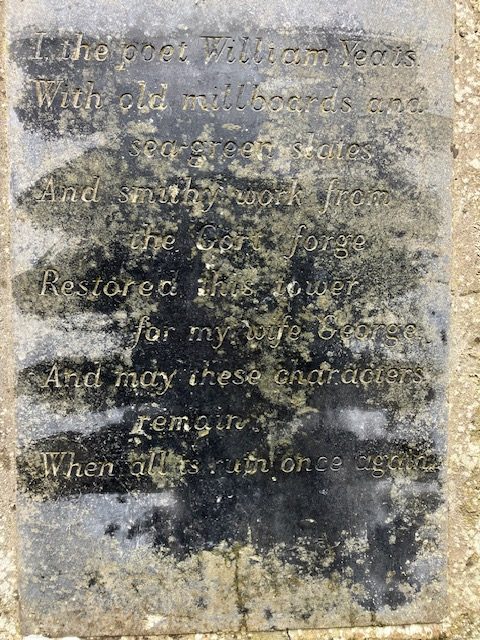
Anyone familiar with the poem “To Be Carved On A Stone At Thoor Ballylee” will be pleased to know that the poem really does appear carved on a stone on the wall of the tower. It’s a bit hard to read in the photo. For those unfamiliar, it reads:
With old millboards and sea-green slates
And smithy work from the Gort forge
Restored this tower for my wife George
And may these characters remain
When all is ruin once again
Numerous prior drafts of this poem exist in his collected letters. Early versions threatened a curse upon anyone who tampered with the tower; the final version is considerably less menacing. I love the fact that he considered this poem an integral design element from early on.
The tower is worth a visit for diehard fans, but be aware: it’s sort of in the middle of nowhere, so you’ll need a car to get there.